
AGP · EN
Security and passport control at Málaga Airport
Every departing passenger at Málaga-Costa del Sol goes through security screening on floor 1 before reaching the boarding gates. If your flight leaves the Schengen area, for example to the UK or Ireland, you also pass passport control, which is a separate check run by the Policía Nacional. This page explains what to prepare for each, what the airport does and does not publish, and what the EU's Entry/Exit System (EES) and the coming ETIAS mean for you.
Do I go through passport control at Málaga?
Domestic or Schengen flight (Madrid, Barcelona, Paris, Amsterdam, Oslo)
United Kingdom
Ireland or Cyprus
Any other non-Schengen country (Morocco, USA, Turkey)
At Málaga Airport, assume the standard liquids rule: containers of up to 100 ml in one transparent resealable bag of up to 1 litre, with laptops and tablets taken out of your bag. Arrive 3 hours before a non-Schengen flight (including the UK and Ireland) and 2 hours before a domestic or Schengen flight. Non-EU passengers such as British citizens are registered in the EES at passport control and no longer get a passport stamp; ETIAS is not yet in operation.
Practical information
Arrive
Liquids
Electronics
Boarding pass
Fast Lane
EES
ETIAS
Who does what
| Check | Responsible |
|---|---|
| Security screening rules (liquids, prohibited items) | EU and Spanish aviation-security law; AESA is the national authority |
| Checkpoint infrastructure, Fast Lane, information desks | Aena, the airport operator |
| Identity documents at check-in and boarding | Your airline |
| Passport control, EES registration, entry questions | Policía Nacional |
| Customs on arrival | Agencia Tributaria (see customs) |
Aena states plainly that it does not check your travel documents: the airline does, under Spain's National Security Programme for Civil Aviation, and the Policía Nacional does at the border. Security is about what you carry; passport control is about who you are and your right to enter or leave. They are different queues with different staff.
Aena advises arriving 3 hours before non-Schengen flights and 2 hours before domestic and Schengen flights at Málaga. It also asks passengers who must pass passport control to go to the boarding area as soon as the gate appears on the screens.
The security checkpoint, step by step
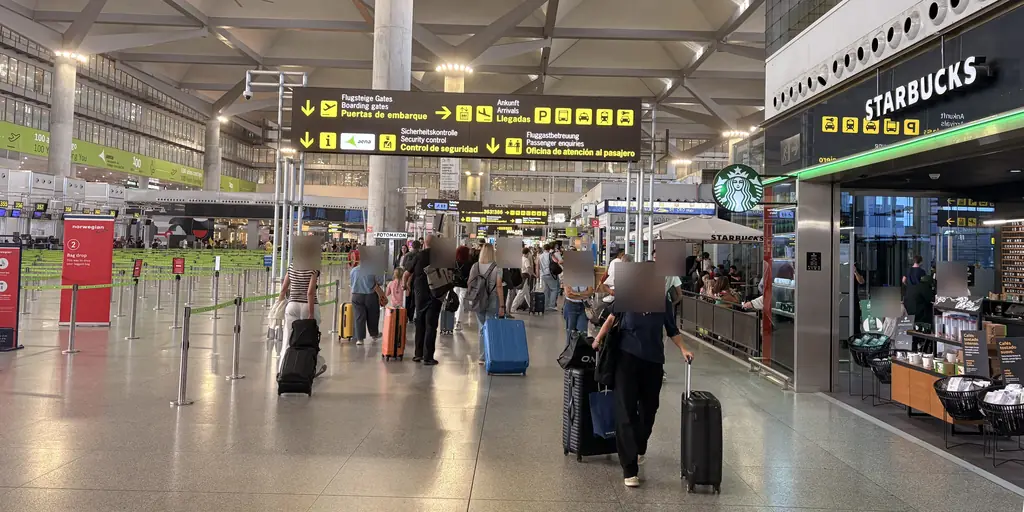
Security is on floor 1. Boarding areas B, C and D are all reached through security in the departure hall. Follow the signs; Aena does not publish a list of checkpoints.
- Boarding pass. You are asked for it before you enter the checkpoint. A mobile pass works: the readers detect the airline's code on your phone.
- Trays. Put in everything from your pockets, plus jackets, hats and footwear with high or wedge heels. Keys, phones and small items go in the trays so they are scanned.
- Take out your liquids bag and your electronics, each in a separate tray. Medicines go separately, outside the liquids bag.
- Pushchairs, cots, baby seats, crutches and walking sticks go through the X-ray separately.
- Walk through the metal-detector arch. If you cannot (for example because of a pacemaker, implant or prosthesis), tell the staff before you reach it and ask for the alternative procedure.
- Expect to open containers if asked. Liquids that fail inspection, or that you refuse to have checked, cannot go through.
No photos or video at the checkpoint. Aena prohibits recording there without authorisation under Law 21/2003 on air security; material recorded in breach is confiscated and destroyed.
Staff may refuse access to any passenger carrying an item that, while not prohibited, raises their suspicions. Where several rules apply to an item (security, dangerous goods), the strictest one wins.
Liquids and duty-free
Pack liquids the standard way: containers of up to 100 ml inside one transparent resealable bag of up to 1 litre (about 20 x 20 cm), fully closed. That covers drinks, perfumes, creams, gels, foams, aerosols, shampoo and toothpaste. Each passenger, children included, may carry one bag, and it goes in the tray separately from your luggage.
Some European airports have relaxed this rule with newer screening equipment. Aena publishes no such relaxation for Málaga, and its instructions for the standard lanes and the Fast Lane are the same, so assume the standard rule applies. If a sign or an officer at the lane tells you something different, follow them.
The liquids limit does not apply to checked baggage.
Duty-free and on-board purchases. Drinks, cosmetics and perfumes bought after security or on board may exceed 100 ml if they stay in the sealed security bag with the receipt. Do not open the bag until your final destination, which matters if you are connecting.
Laptops, power banks and e-cigarettes
Laptops, tablets, phones, external batteries and hard drives must come out of their cases or sleeves and go in separate trays.
- Power banks and spare lithium batteries: cabin only, never in checked baggage. Each must be protected against short circuit, up to 100 Wh (160 Wh with airline approval, maximum two). You may not use a power bank to charge devices during the flight.
- Electronic cigarettes: cabin only, never in the hold, and no recharging on board.
- Damaged, defective or recalled lithium batteries or devices may not be carried at all.
For smart suitcases, mobility aids and batteries in the hold, see baggage.
Medicines, medical devices and baby food
Liquid medicines needed during your journey (outward flight, stay and return flight) are exempt from the 100 ml limit. Aena's instruction is to present them separately at the checkpoint, outside the plastic liquids bag. Carry the prescription or proof of your condition where you can; staff may check it. Solid medicines are allowed.
Syringes and other medical items that fall into a prohibited category need a medical certificate in your hand luggage. Tell your airline beforehand about syringes for diabetes, measuring devices and similar equipment.
Baby food and milk (liquid milk, water, juices and so on) needed for the journey are allowed and exempt. Other liquids for babies follow the normal rule. Carry proof of the specific need if you can.
Food in hand luggage is fine in small amounts for personal consumption, within your airline's limits and subject to the rules on animal and dairy products at your destination (see customs).
Prohibited items and what happens to them
Not allowed in the cabin: firearms and weapons (they need authorisation and travel in the hold, see baggage), devices that fire projectiles, stun devices, objects with a sharp point or cutting edge, blunt instruments, tools that can cause serious injury, flammable, explosive and incendiary items, and chemical or toxic substances. Many of these can go in checked baggage instead. Crutches and walking sticks you need for mobility, and foldable trekking poles, are allowed.
If security finds a prohibited item, Aena gives you three options: check it in as hold baggage, hand it to someone who is not travelling, or put it in the bins at the checkpoint. Items in the bins are treated as waste and cannot be returned to you, and the lost property office cannot recover them.
Fast Lane, family lane and the hidden-disabilities badge
Fast Lane is Aena's paid priority access to security at Málaga, on floor 1, departures zone, open 24 hours. Some airlines include it for business fares and loyalty-card holders. At the door, hold the QR code to the reader, then your boarding pass. It shortens the queue to the checkpoint only: Aena states it does not exempt you from screening, and it does nothing at passport control. Aena's separate Fast Track product is not sold at Málaga. For price, validity and booking conditions, see Fast Lane at Málaga Airport, and buy only through Aena's official channel.
Family and reduced-mobility lane. Aena has said Málaga has a security lane for families and passengers with reduced mobility, and the hidden-disabilities badge is intended to give the holder and their companions access to it. Aena does not publish where it is or when it is open, so ask at the Barrier Free desk or show the badge at the filter and ask; staff will direct you.
Aena's hidden-disabilities badge can be used at Málaga-Costa del Sol. It is single use, on the day of your flight, and can be shown printed or on a phone; one badge covers a family group. It is not a fast lane: Aena states it gives no accompaniment service, no preferential access to security and no exemption from any departure or arrival procedure. A sunflower lanyard is not the same: Aena states it does not give access to the family/PRM security controls.
Passengers who need help can book Aena's free Barrier Free assistance, whose staff accompany you through security and passport control. See special assistance.
Passport control: who goes through it
Aena groups flights into three types: Schengen (no passport control), non-Schengen EU (Ireland and Cyprus) and other countries, which include the United Kingdom.
- Departing to a non-Schengen destination: you pass passport control after security, on the way to your gate. Aena does not publish the exact position of the passport-control points.
- Arriving from a non-Schengen origin: you pass passport control before the baggage reclaim hall on floor 0.
British passengers. The UK is outside both the EU and Schengen. British citizens are processed as non-EU nationals: the officer checks your passport, the EES records your data, and you may be asked about the purpose of your visit, where you are staying, your return journey and your means of support. Aena's Brexit page still mentions a passport stamp; the European Commission states that the EES has replaced stamping since 10 April 2026. Third-country nationals entering Spain need a passport valid for at least 3 months beyond the date they plan to leave the Schengen area, issued within the previous 10 years.
Irish passengers. Ireland is in the EU but outside Schengen, so you clear passport control at Málaga even on a flight to or from Dublin. As EU citizens you use the EU/EEA/Swiss lanes and are not registered in the EES.
UK nationals living in Spain. Aena lists a current residence permit for Spain as valid documentation for non-EU nationals. Carry your residence card (TIE) with your passport; the EES is designed for short-stay visitors.
Minors. Border police pay particular attention to minors. A child travelling on an identity card alone needs written parental permission; for Spanish minors leaving Spain, check the Ministry of the Interior's requirements.
EES and ETIAS
The Entry/Exit System (EES) is in operation. It started progressively on 12 October 2025 and has been fully operational since 10 April 2026. It registers non-EU nationals travelling for a short stay (up to 90 days in any 180) each time they cross the external border of the 29 participating European countries. At the border your passport details are recorded, your facial image and fingerprints are taken, and the date and place of entry and exit are logged. There is no advance application, and passports are no longer stamped. EU, EEA and Swiss citizens, including Irish citizens, are not registered.
ETIAS is not in operation yet. As at 9 October 2026, the European Commission states that no ETIAS applications are being collected. It is scheduled to start in the last quarter of 2026, and the exact date has not been officially announced. When it starts:
- it will apply to visa-exempt non-EU travellers visiting 30 European countries (the 29 Schengen countries plus Cyprus), including British and US citizens;
- you will apply online through the official ETIAS website or app, and the fee will be EUR 20;
- approval will be linked to your passport and valid for 3 years or until the passport expires, and airlines will check it before boarding.
Any website selling you an ETIAS today is not an official channel. EU citizens and holders of a valid visa do not need ETIAS. Check the Commission's pages before you travel, because the start date may be announced at any time.
UK ETA, US ESTA, documents and lost passports
Flying from Málaga to the UK: the UK ETA. The UK requires an Electronic Travel Authorisation from most visitors who are not British or Irish citizens. GOV.UK states it costs £20, allows trips of up to 6 months, does not guarantee entry and is needed by every traveller, including babies and children. You do not need one if you are a British or Irish citizen, already hold a UK visa or permission to live, work or study in the UK, or meet one of GOV.UK's other exemptions. Dual British or Irish citizens cannot get an ETA and should travel on their British or Irish passport. Apply only on GOV.UK. Fee checked 9 October 2026.
Flying to the USA: ESTA. Aena notes that Spain is in the US Visa Waiver Program and that the travel authorisation must be completed online at least 72 hours before boarding, at esta.cbp.dhs.gov.
Which document. For non-Schengen destinations you need a valid passport; some countries also require six months' validity beyond your travel date and a visa. A non-current Spanish DNI or passport is accepted only on domestic Spanish flights, and only for Spanish and EU/Schengen passengers; it is not valid for international travel.
Lost or stolen passport. Report it to the Policía Nacional at the airport, tel. (+34) 952 231 620, on floor 0 (external terminal), then contact your own embassy or consulate for an emergency travel document. Aena does not issue documents or publish consular contacts. The Guardia Civil at the airport is on floor 1, check-in area, tel. (+34) 951 462 295 or 062.
EES and ETIAS: the European Commission's status page
Travel tips
- Allow the full 3 hours for a UK or other non-Schengen flight; Aena itself tells passport-control passengers to head to the gate as soon as it appears.
- Pack your 1-litre liquids bag before you leave and put it where you can reach it at the tray.
- Keep liquid medicines out of the liquids bag and present them separately, with the prescription if you have it.
- One liquids bag per person, children included.
- Have your boarding pass ready before the checkpoint entrance; a phone pass works.
- Fast Lane shortens the security queue only; it does not help at passport control.
- Do not buy an "ETIAS" now: the European Commission says no applications are being collected yet.
- British and Irish citizens flying home to the UK do not need a UK ETA.